Dancehall, sexuality, and the cultural work happening in a catalogue most people only hear as scandal.
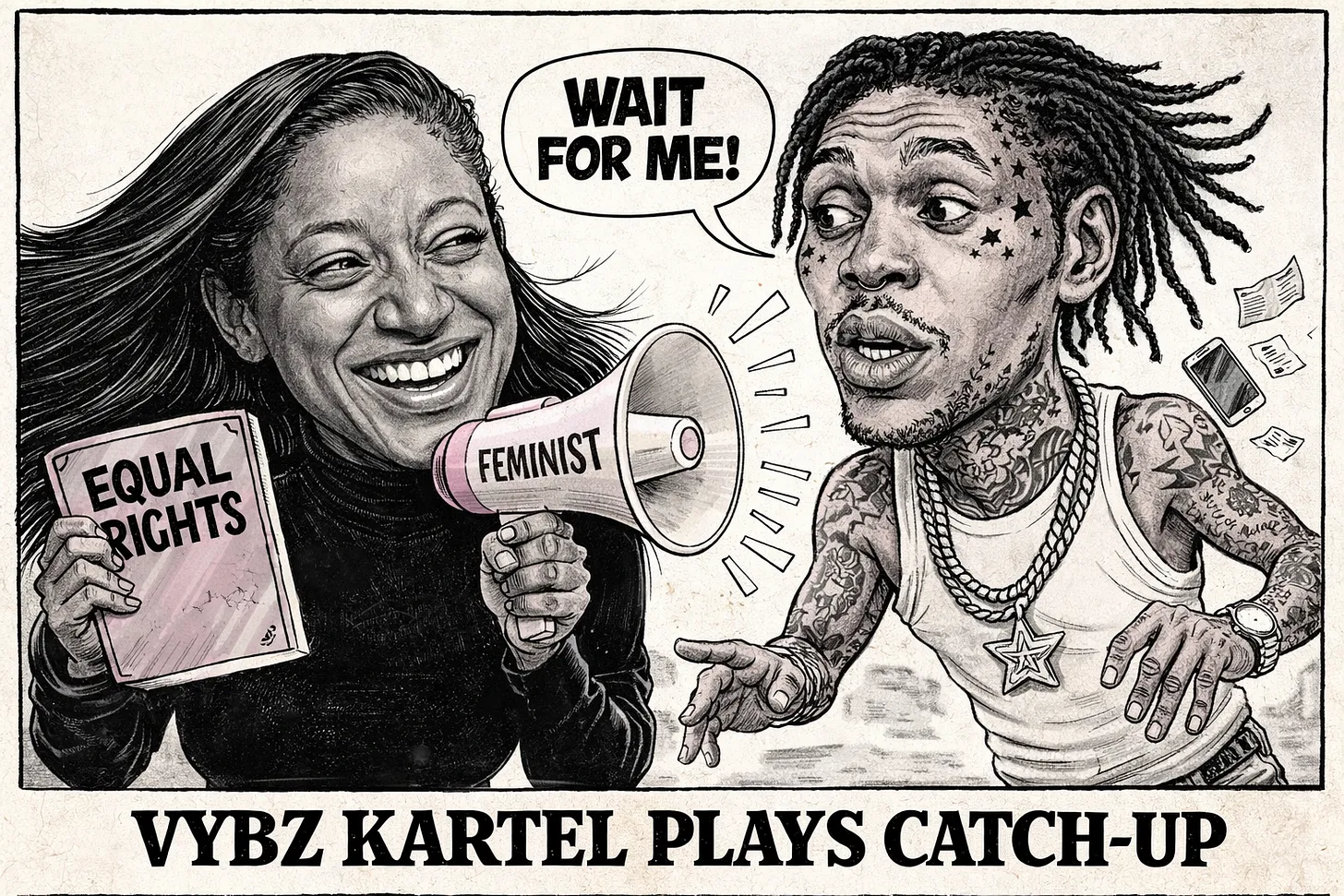
I get into arguments about this all the time. Uusally heated ones.
Friends agree with the first half of my position; that Vybz Kartel is one of the most lyrically gifted artists of all time.
And then look at me with confusion, and sometimes disdain when I say the second half:
That much of his catalogue has quietly moved the needle for women in Jamaica, and by virtue of this, how Jamaicans think about feminism.
Not intentionally.
Almost certainly not ideologically.
But culturally.
The distinction matters.
Kartel’s character and Kartel’s lyrics are two very different conversations. The man has spent years entangled in controversy, including a murder conviction that was later overturned after juror misconduct was identified in the trial.
None of that disappears.
However, as I’ve said elsewhere, culture rarely moves forward because its messengers are morally tidy.
Sometimes the shift happens because a song refuses to say the thing everyone else keeps repeating.
The head conversation (dancehall edition)
To understand Kartel’s role here you have to understand a very specific Jamaican cultural rule that existed since the beginning of time.
Women giving head was often framed as embarrassing. A cheat code for men. Something that women should be coerced into.
The act itself happened obviously, but admitting it publicly was treated like social suicide.
Dancehall reinforced the rule constantly.
Take Mr. Vegas and his massive late-90s hit “Heads High.”
The chorus became a national instruction manual:
Heads high, kill dem wit it no, just mek a bway know you nah blow. Heads high, kill dem wit no, no bway ain’t got no secret fi yow
The message was clear.
Respectable women did not participate in that kind of behaviour.
Then Kartel arrived and treated the entire script like it was optional.
Across multiple songs he references women performing oral sex with zero embarrassment and a surprising amount of enthusiasm.
One clear example is the song Go Go Club by Vybz Kartel.
In the track Kartel references oral sex directly in a matter-of-fact way as part of sexual pleasure rather than something embarrassing for men. One of the most quoted lines is:
“She love fi go down pon it.”
The framing is typical of Kartel’s sexual lyrics: the woman is depicted as enthusiastic and active rather than shaming the act or treating it as something degrading.
Another example appears in Romping Shop, his duet with Spice. The song is essentially a back-and-forth sexual conversation between the two artists where explicit sexual acts are discussed openly by both partners.
That duet is important culturally because it presents a reciprocal sexual dialogue:
both the man and the woman speak about their desires, rather than the woman existing only as the object of the man’s narration.
In Jamaican cultural terms, that was disruptive.
Another line that gets quoted endlessly:
“P***y come in like Bible.”
Which is a wild metaphor.
And also a revealing one.
In Jamaica the Bible is not just a religious text. It’s a cultural object. Something sacred, respected, treated with a kind of everyday reverence. It sits in living rooms, courtrooms, and bedside drawers. Politicians swear on it. Grandmothers quote it.
So when Kartel reaches for a comparison, that is the one he chooses.
Women ‘s bodies, made by God, equal to scripture.
It’s a dancehall exaggeration, of course. Kartel’s lyrics live in that space where shock, humour, and admiration blur into each other.
The theology might not pass inspection in a Sunday sermon.
But as dancehall logic goes, the point is clear.
Kartel’s metaphors often treat women’s bodies less like a problem to control and more like something to celebrate.
Which, coming from a genre that has not always been generous to women, lands with surprising force.
And then the women responded
What Kartel’s openness also did, again, intentionally or not, was create space for female artists to speak just as directly about their own pleasure.
Enter Ishawna.
Her track “Equal Rights” took the entire conversation and flipped it.
“Bumper to your forehead, show me what your tongue can do”
It’s one of the most openly reciprocal sexual arguments ever recorded in dancehall.
The song then goes further:
“You neva hear bout foreplay. A modern time now boy, relax its okay”
Which might be the most Jamaican articulation of feminist bargaining ever put on a riddim.
Kartel normalised talking about the act.
Ishawna demanded equality inside it.
Cultural evolution, dancehall edition.
Mothers, survival, and Thank You Jah
Then there’s “Thank You Jah.”
This is the Kartel that people who only know the scandalous lyrics tend to miss.
In the middle of a song reflecting on poverty, survival and the struggles of ghetto communities, he pauses to acknowledge single mothers:
“Big up di gyal dem weh fight it alone
An a raise two three pickney ‘pon dem own
Weh di man deh? No man nuh deh home.”
Nearly half of Jamaican households are headed by women, and around 47% of children live in single-parent homes with their mothers. So in Jamaica, where single motherhood is common and often economically brutal, that line lands differently.
Female artists and the Kartel orbit
Kartel’s catalogue also contains an unusually large number of collaborations with female artists.
Lisa Hype is one example, but the list runs much longer — from Spice to Gaza Slim, Tiana, Sheba, J Capri, Pamputtae, and a range of lesser-known women who gained visibility through his productions and the Gaza platform. In fact, many would argue that he put Shenseea on the map almost accidentally when she used a sample of his voice for the chorus of “Loodi,” a track that quickly pushed her into the centre of the dancehall conversation.
What stands out is the way Kartel often positions women within the song.
In many tracks, the woman is not a background voice or decorative feature. She carries verses. She answers him directly. Sometimes she dominates the entire premise of the song. The structure becomes conversational, almost theatrical; a back-and-forth between male and female perspectives rather than a one-sided performance of male bravado.
For emerging female artists, those features mattered. Dancehall has historically been a space where male artists dominate bookings, radio play, and production networks. A Kartel collaboration functions as a kind of amplifier, introducing women to audiences that might not otherwise have encountered them. In particular male audiences, given that male listeners stream about 94% male artists and only around 3% female artists
The Gaza ecosystem in particular operated as a pipeline. Female artists connected to the camp were often able to move from relative obscurity into wider circulation within the dancehall economy.
None of this makes Kartel a feminist figure.
But it does complicate the usual dancehall script.
The uncomfortable part
Kartel’s catalogue also includes problematic lyrics.
Violence.
Homophobia.
The full catalogue of dancehall “slackness.”
None of this disappears simply because some songs complicate the picture.
Kartel himself has acknowledged regret about some earlier lyrics and how cultural norms shaped what artists felt able to say publicly.
Which is another way of saying: artists evolve.
Sometimes slowly.
So what exactly is the argument?
Kartel is not a feminist.
Let’s not get carried away.
The argument is that culture shifts through strange messengers.
Inside a heteronormative, hyper-masculine dancehall culture; one that often treats women as property or props, Kartel’s lyrics occasionally carve out space for something more complicated:
Women as sexual agents.
Women as collaborators.
Women as mothers holding communities together.
And often positive representation of women at the centre of the entire song.
Is it messy?
Of course.
Dancehall is messy.
But if you grew up listening closely to dancehall lyrics, the same way people dissect Kendrick Lamar verses today, it becomes difficult to ignore how many of Kartel’s songs quietly pushed the conversation forward.
Whether he meant to or not.
Which is why the arguments continue.
Usually loudly.
Usually over rum.
And usually ending with someone reluctantly admitting:
Yes.
The man can write.