Content note: This piece discusses sexual violence, including personal and systemic experiences of harm. Please read with care
“There are worse things than rape.”
Olivia Pope said it.
Shonda Rhimes wrote it so definitively, you were meant to accept it without pause.
It stayed with me because of how easily it asked to be believed.
Because if we are honest, there isn’t much that sits beyond it.
I know many of us know there are experiences the body does not easily recover from. Death feels finite. This lingers. It settles into the body, into memory, into the way you flinch when someone taps you on the shoulder in a train station. The way affection feels like intrusion when someone hugs you from behind.
Sexual violence reshapes what safety means. The consequences are lived and sustained.
Psychologically, it is linked to post-traumatic stress, depression, anxiety, dissociation, and suicidal ideation.
Physically, it is associated with chronic pain, gastrointestinal disorders, reproductive health complications, and increased risk of sexually transmitted infections.
Socially, it fractures relationships, isolates survivors, and embeds stigma.
Economically, it disrupts education, employment, and long-term stability.
And still, the formal systems we rely on to respond to that harm often struggle to provide safety or justice.
Globally, around one in three women experience physical or sexual violence in their lifetime. In many jurisdictions, fewer than 10 percent of reported sexual offences result in conviction.
In Jamaica, the patterns are just as stark. Over 2,100 children were reported as victims of sexual offences between January 2023 and May 2025, across more than 3,000 reported cases. Conviction rates remain low. In 2011, for example, over 2,600 reported rape cases resulted in just 23 convictions in rural circuit courts. Backlogs persist. Forensic evidence processing can take years.
These are not isolated failures. They are patterns.
I met those patterns in the form of a woman I will call Vanessa.
She reported her assault. The police informed the man she had accused. No protective measures followed.
Seven months later, pregnant as a result of that first assault, she was raped again, this time by a taxi driver who had been transporting her to and from work. She contracted HIV.
Years later, her case had still not been heard. Her rape kit remained unprocessed.
Her experience sits inside a wider set of institutional constraints: limited forensic capacity, procedural delays, and resource shortages. In 2013, only about 10 percent of complaints to the Public Defender’s Office were resolved, while hundreds of sexual offence cases were carried forward year to year. These are the conditions that shape whether reporting leads to accountability.
And sometimes, the harm is compounded inside the very systems meant to respond to it.
There are women who go to report sexual violence and are assaulted by the officers they turn to.
Judges who suggest women should manage their husbands’ tempers and shame them in court
Politicians who dismiss calls for accountability with “none of this Me Too business,” followed by laughter that lands exactly as intended.
These conditions shape how survivors understand justice.
It was from within that reality that I began asking questions about restorative justice.
At eighteen, I was sexually assaulted. I did not report it. In part, because no one I knew had ever reported it, even though I knew so many who had experienced the same.
I also understood something else, even then.
The boy who harmed me was eighteen too. His life had been shaped by harm long before it intersected with mine. An abusive father. A home fractured by substance abuse. A world that taught him power without responsibility.
That does not excuse what he did.
But it does tell us something important.
Harm does not disappear because we imprison it.
If we do not understand it, we do not change it.
Restorative justice begins from that premise.
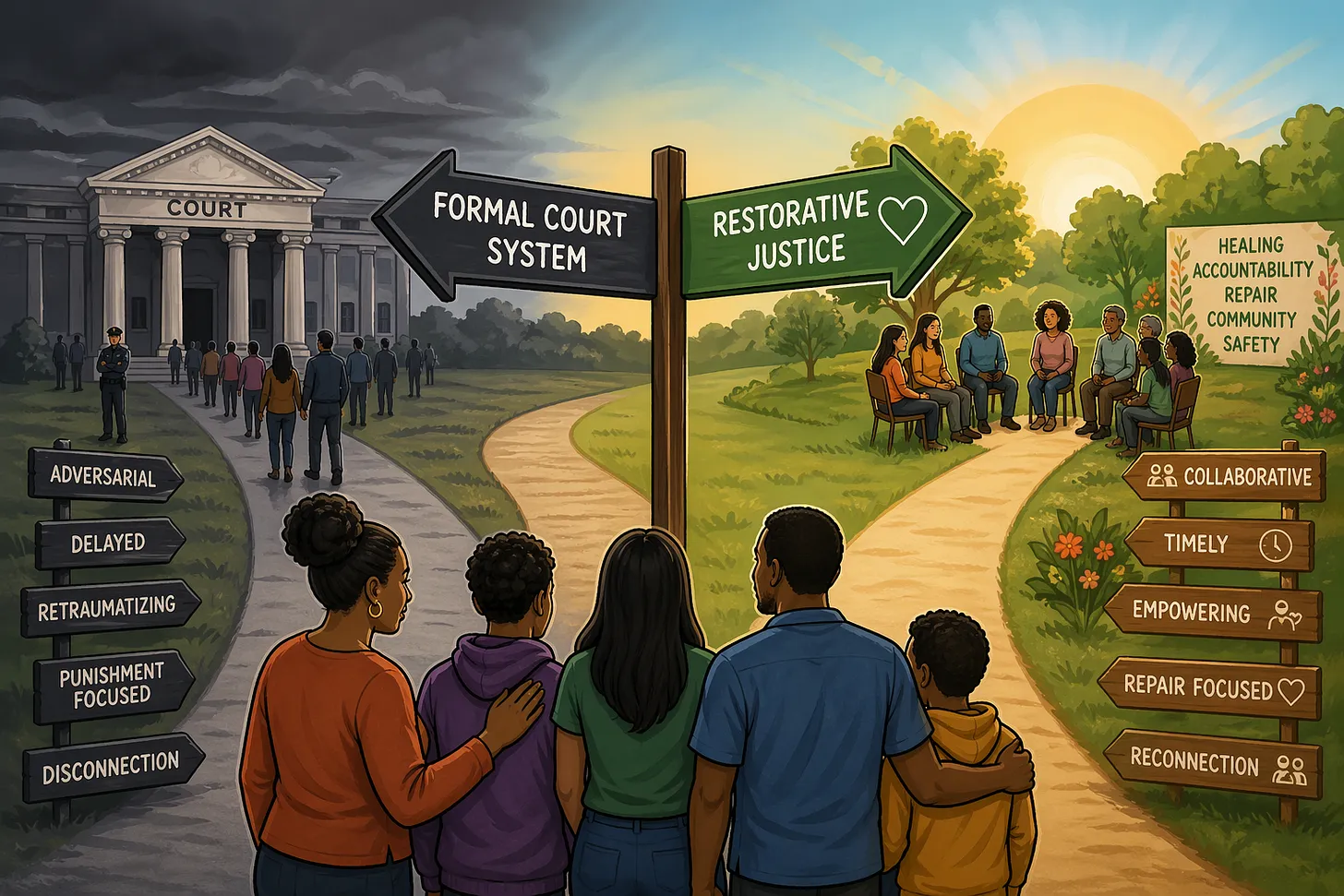
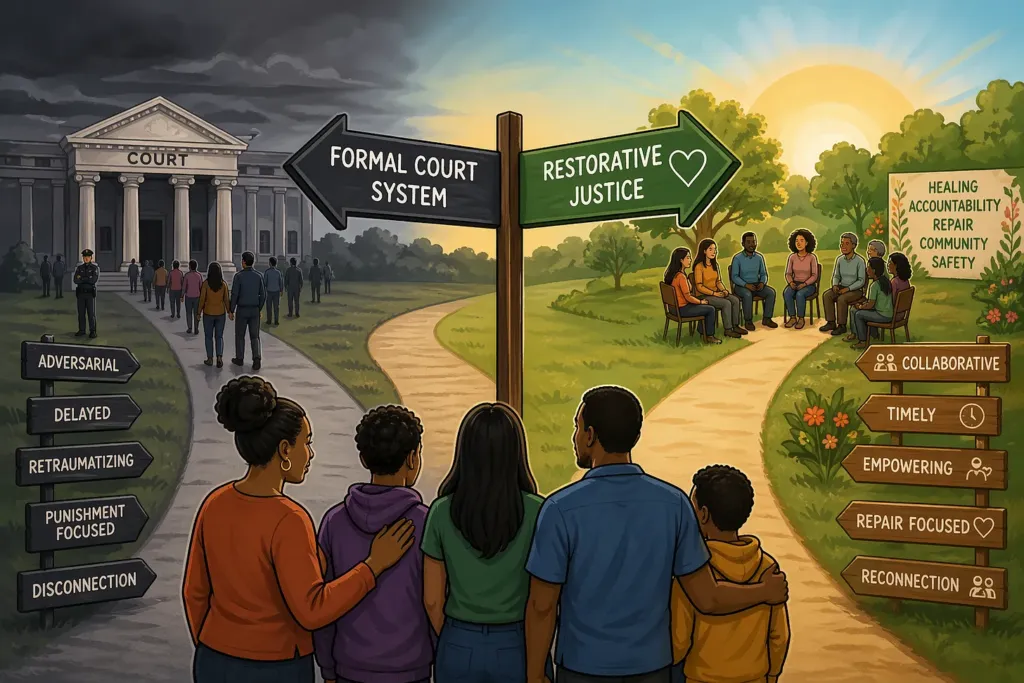
At its core, it is a structured process that brings together those affected by harm; victims, offenders, and sometimes members of the community to address what happened, who was affected, and what is required to repair it. It is facilitated. It is deliberate. It centers accountability, participation, and acknowledgment.
When I began my research in Jamaica, I expected people to reject it, particularly in cases of sexual violence.
What I found was more layered.
There was no ambiguity about the seriousness of these offences. Rape, incest, and child sexual abuse were consistently identified as among the most severe forms of harm. There was strong support for incarceration.
Alongside that, there was openness.
When restorative justice was explained; what it requires, what it asks of those involved, people engaged with it.
Women spoke about wanting acknowledgment. They wanted the harm named directly by the person who caused it. They wanted to speak. To ask questions. To be heard in full.
Many returned to the same point:
They wanted to know it would not happen again. To anyone.
That is where the question of behaviour change becomes central.
Most survivors know the person who harms them. Global estimates place this between 70 and 85 percent of cases.
Sexual violence is relational. It happens within proximity. Within familiarity. Within dynamics shaped by power, entitlement, and learned behaviour.
That matters for how we respond to it.
Because if harm is learned, embedded, and repeated within relationships, then addressing it requires more than distance. It requires engagement with the conditions that produced it.
Where individuals pose ongoing risk, public safety measures remain essential: incarceration, supervision, specialised intervention. Different forms of harm require different responses.
Restorative justice operates within that broader landscape.
It asks something specific of those who have caused harm. To acknowledge what they have done in clear terms. To listen to its impact. To take responsibility in ways that are visible and sustained.
This matters because research on sexual offending consistently identifies denial, minimisation, and cognitive distortion as central drivers of repeat harm. If those patterns remain unaddressed, the risk remains.
Restorative justice creates structured conditions to confront them.
It brings the underlying behaviours into the open. It requires engagement with them. It makes accountability active rather than abstract.
And there is evidence to suggest that actually reduces crime.
In one study of youth sexual assault cases in South Australia, reoffending rates were 48 percent for those who participated in restorative processes, compared to 66 percent for those processed through the formal court system. Evaluations of Circles of Support and Accountability have found reductions in sexual reoffending of up to 70 percent among participants.
For survivors, the impact is different, but no less significant.
Restorative processes create space for participation. Survivors are able to describe harm in their own words, ask questions, and receive acknowledgment. Research shows that many value processes that allow for voice, validation, and meaningful engagement.
For communities, something shifts as well.
Sexual violence is encountered as it occurs; relationally, contextually, often close to home. Accountability becomes visible. Responsibility becomes specific. Over time, that begins to reshape how harm is understood, and what is expected in response to it.
I saw that shift in the data.
Initial resistance moved into conditional engagement. Openness increased when safeguards were clear. Even in relation to sexual offences.
Because what we accept as justice shapes what we build.
And if the goal of a justice system is to improve upon the status quo and prevent harm, we have to be honest about where it falls short. At times, it does more than fail to respond, it can deepen harm. That means being willing to rethink what justice is designed to do.
Not only how it punishes, but whether it changes anything.
This sits with Vanessa.
It sits with the woman told she was too old to be raped.
With the girl who speaks out against her teacher and is met with protest demanding her removal.
With the woman told she provoked the violence that left her with stitches.
It sits with the version of me who understood, at eighteen, what reporting could mean in practice.
Restorative justice responds to that reality.
It asks the person who caused harm to face it.
It centers the person who experienced it.
It recognises the role of the community in both harm and repair.
And it creates the possibility that justice can do more than name harm.
That it can respond in ways that reduce the likelihood of it happening again.
Justice as prevention.
Justice as repair.