I was sitting on the tennis court, half listening, half thinking about how to fix my serve; far more important than listening to men talking with too much confidence about women they do not know.
One of the guys was relaying a story about a woman who got called out for lying. Then he said it. Casual. Certain. Clean as a forehand.
Those are the kind of women who call rape and are lying.
And just like that, we moved from the tennis court to the colonial courtroom.
The one where women seeking justice are asked how many sexual partners they’ve had. What they were wearing. Whether they drank. Whether they stayed.
Where the first question is never what happened to her? but what kind of woman is she?
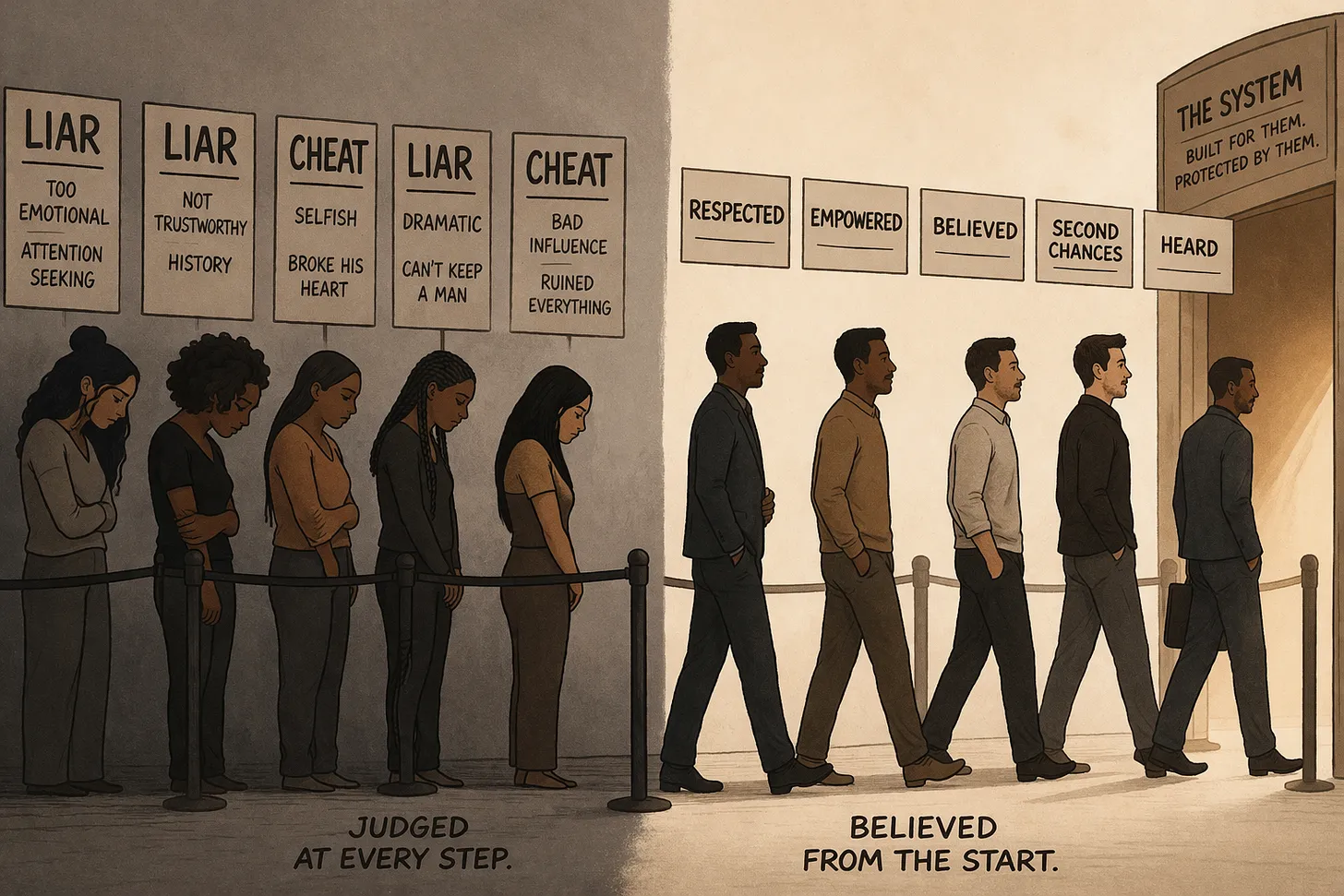
For generations, women have learned that the truth is not the point. Not harm. Not evidence. Only character. Respectability. A quiet, persistent obsession with deciding whether a woman is good enough to be violated and still count as violated.
We still want a perfect victim.
A woman who is modest enough.
Soft enough.
Sober enough.
Consistent enough.
Unmessy enough.
A woman whose pain arrives in the right packaging.
And if she lied about something else? If she cheated on her taxes, cheated on her partner, sold sex, said the wrong thing, wore the wrong thing, stayed too long, came back, forgave him once, texted him after, laughed too loudly, wanted attention in some other part of her life?
Then suddenly people act as if she has crossed some invisible moral line and forfeited the right to be believed.
As if being a flawed woman and being a harmed woman are mutually exclusive categories.
They are not.
A woman can be selfish and still be raped.
A woman can be manipulative and still be raped.
A woman can be promiscuous and still be raped.
A woman can be a sex worker and still be raped.
A woman can be deeply unlikeable and still deserve justice.
The fact that this still feels radical to some people shows how committed we are to the fantasy of female purity.
It is why people still talk about false accusations as if they are the central crisis, even though the data does not support the panic. In England and Wales, the government’s own rape review found that up to about 3% of rape allegations could be false. The same review noted that less than 20% of victims report rape to police at all. Rape Crisis England & Wales puts it even more plainly: 5 in 6 women who are raped do not report to the police, and nearly a quarter say it is because they believe they will not be believed.
So women are not hurling themselves toward police stations, courts, tabloids, and public humiliation because lying about rape is easy sport. They are staying quiet because telling the truth is often punished.
We spend time discussing the hypothetical damage done to men by false allegations. We spend far less time sitting with the very real damage done to women and girls who speak.
Sometimes that damage is public annihilation. Amber Heard testified that after speaking about abuse she faced daily harassment and death threats. A woman says she was harmed, and the world responds by turning punishment into entertainment.
Sometimes that damage is career retaliation. The U.S. Equal Employment Opportunity Commission found that 43.5% of sexual harassment charges filed between 2018 and 2021 were filed alongside a retaliation claim. Nearly half.
Sometimes that damage is institutional betrayal.
In Jamaica, the law still tells its own story. Under the Sexual Offences Act, a husband can only be charged with marital rape in limited circumstances: if spouses are separated, in divorce proceedings, under a protection order, or if he knowingly has an STI. The law is less concerned with a woman’s lack of consent than with the conditions that make her legible enough to the state.
I once spoke with a Member of Parliament in Jamaica about marital rape, and the reasoning offered was familiar: the fear of vengeful wives. The idea that a woman’s possible spite is more threatening than a man’s actual violence.
Are victims not allowed to be angry?
Are they not allowed to feel vengeful, even if they do not act on it?
Are they meant to emerge from violation morally elevated, carrying trauma with grace so the rest of society can remain comfortable?
We live in cultures shaped by retaliation. Men kill over disrespect. People fight over a look, a word, a shoe stepped on in a dance. Nations go to war over bruised pride and call it strategy. Institutions retaliate and call it policy.
But when a woman is sexually violated, she is expected to become something else entirely.
And if she is not? If she is furious? If she wants the person who harmed her to face consequences, even if those consequences are financial?
People act as though that desire contaminates the truth of what happened to her.
It does not.
Wanting accountability is not the same as fabrication.
Anger is not evidence of deceit.
Imperfection is not proof of a lie.
Part of what makes the “perfect victim” myth so dangerous is that it distorts how harm actually happens. Men are often charming, polite, trustworthy. That is how access is gained. That is how harm is made possible.
Women are not offered that same complexity.
Men are allowed to be polished and dangerous.
Women are expected to be pristine and harmed.
That is the trick.
He can be charismatic and still dangerous.
She can be chaotic and still telling the truth.
Both things can be true.
In many cases, survivors face direct threats from their attackers after reporting. Amnesty International has documented cases where women reporting rape faced secondary victimization, including indifference, blaming, or harassment by police officers. A woman in New York reported that she had been raped. Instead of being protected, she was later raped by the police officer assigned to investigate her case, who used his authority and access to her as a survivor to assault her.
We have also watched survivors live under the weight of what disclosure costs. Virginia Giuffre, who spoke publicly about abuse linked to Jeffrey Epstein, died by suicide in April 2025. Her family spoke about the toll of lifelong abuse.
RAINN notes that survivors of sexual violence face significantly higher risks of long-term trauma and suicide.
So when people say that certain kinds of women are the ones who “call rape and lie,” what they are really saying is this:
I have already decided that only some women count.
Only clean women.
Only gentle women.
Only women whose lives can be arranged into innocence.
The truth is:
Some victims are brave and some are scared.
Some are consistent and some are traumatised.
Some are gentle and some are furious.
Some are admirable and some are hard to like.
Some are virgins.
Some are wives.
Some are sex workers.
Some are liars about other things.
Some are women you would never invite home to meet your mother.
And all of them can still be raped.
All of them can still be harmed.
All of them can still deserve justice.
All of them can still be telling the truth.
The perfect victim does not exist.
She was invented so the rest of us could keep excusing what men do to imperfect women.