
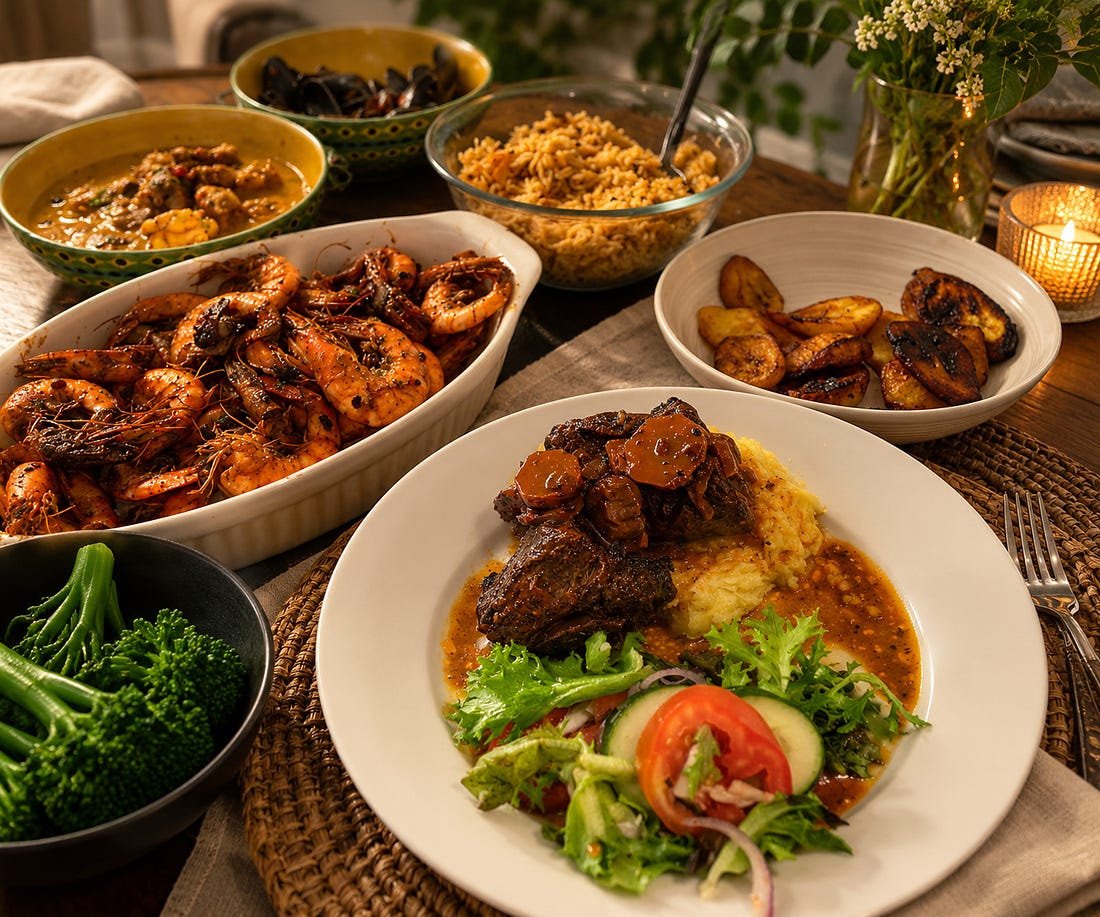
There is a running joke among the people I cook for that if I haven’t cut or burned myself somewhere in the process, the food probably wasn’t made with love.
I am a deeply clumsy person who has somehow chosen a hobby involving sharp knives, open flames and cast-iron pots heavy enough to crush a toe. There is usually a plaster somewhere on my hand by the time dinner reaches the table, occasionally a fresh burn along my forearm where I have forgotten, again, that the side of the oven is hot. I keep cooking anyway, because somewhere along the way feeding people became one of the ways I learned to love them.
Food was always woven into the rhythm of our house. We were people who liked to eat, liked to eat out, and understood celebrations partly through what would be on the table when we got there. Christmas dinner had its own ritualised menu, as did Christmas morning, when Daddy would disappear into the kitchen to make his eggnog from a recipe he guarded as though generations were waiting to inherit it.
None of us wanted the recipe because, frankly, none of us liked eggnog.
Mummy did, which made her the essential accomplice in a remarkably organised operation in which my siblings and I took turns sliding our glasses towards her whenever Daddy’s back was turned. She would drink one after another while maintaining a completely straight face and a milky mouthstache, praising how delicious it was and occasionally sending him back to the kitchen for more. I don’t remember who devised the rotation or how we ensured Daddy never noticed that three children who hated his eggnog were somehow finishing every glass, but I remember the conspiratorial movement of cups across the table and Mummy happily absorbing the evidence.
Our family table was an extension of the places we came from. Daddy had taught Mummy to cook because she hadn’t really needed to before she married him, and she became very good at it, the kind of good that leaves you years later trying to recreate a taste from memory and getting irritated when you can’t. There was beef curry with roti, Jamaican Sunday breakfasts of ackee and saltfish with boiled banana, lasagne, and the usual Saturday trip for Tastee patties, although I should confess that with the benefit of adulthood and the freedom to purchase my own patties, I am now firmly a Juici Beef woman.
Somewhere underneath all of that was a creolised culture of cooking: Jamaican staples carrying Sri Lankan influences, alongside the Western indulgences we had picked up along the way, each place entering my childhood as much through taste and smell as geography.
One of my earliest memories of a kitchen belongs to my Ammamma’s house in Colombo, where the kitchen seemed enormous because I was small, and my brother and I hovered around the cooks making string hoppers, wanting to touch things we almost certainly had no business touching and had never seen before. I remember the strange magic of those thin strands becoming little white nests, the steam lifting around them, the kitchen busy with hands that knew instinctively what came next. Ammamma had fed her own children thosai and string hoppers years earlier, carrying those foods with her even when the family moved between countries, so perhaps I was watching something older than a meal being made, although at the time I was mostly interested in eating it.
I still haven’t made string hoppers myself. I have reached a stage in my cooking life where I will make pasta and marinara from scratch and throw away an entire pot of rice and peas if the colour offends me, yet string hoppers remain a line I haven’t crossed. Whenever I walk into a Sri Lankan restaurant, though, they are the first thing I look for.
There were other kitchens that became part of my education. I spent weekends and summers at my best friend Krissy’s house, lingering near her dad and stepmum while they cooked, volunteering to stir the oxtail in the Dutch pot while the thick brown gravy bubbled around the meat. When bread was baking, the smell travelled through the house, through open windows and rooms lined with dark-stained wood, until even the dogs stationed by the door would catch it, noses shifting first, then heads lifting and turning as they tried to work out where it was coming from.
For all this exposure, I entered adulthood with a confidence in the kitchen that vastly exceeded my ability.
When I moved into the Terrace Apartments for my senior year at Vassar, I decided curry chicken would become one of my dishes. I bought boneless chicken breast, which should have been an early warning, cut it into pieces, seasoned it with curry powder and put it into a frying pan with onions.
That was the entire recipe.
There was no garlic, thyme, scallion, Scotch bonnet, ginger or potato. There was no water or coconut milk, nothing that might have introduced moisture into the situation. I was essentially sautéing increasingly dehydrated pieces of chicken breast in curry powder.
My Trinidadian boyfriend came over, looked into the frying pan, then at me, with the kind of expression that suggested he had just been given an unwanted glimpse into his culinary future. We broke up that semester. He was cheating with my next door neighbour, so the curry wasn’t the problem, although I can’t imagine it helped.
Years later, when both of my parents became ill, cooking stopped being something I occasionally attempted and became part of the daily negotiation of keeping them fed.
Cancer had its own relationship with food. Chemotherapy shifted their palates, sometimes from one day to the next, and things that had been familiar for decades suddenly tasted suspicious. Daddy became convinced that manufacturers were constantly changing recipes. Bread went into the fridge, came out of the fridge, moved to the freezer and returned to the counter while we tried to determine which version tasted least wrong. Cornmeal porridge remained trustworthy because, according to him, they hadn’t changed the recipe.
It was cornmeal, so he had a point.
He became particularly fond of my stew chicken and sweet potato, the chicken cooked until the gravy darkened and clung to the meat that was falling off the bone, the sweet potato soft enough to surrender beneath a fork, even though there was no butter or milk added. He wasn’t fond of our housekeeper and refused to have a nurse, which meant I learned the intimate mechanics of caring for him as his body changed: which clothes were easiest to get over weakening arms, which pyjamas gave access to an IV, which supplements could stand in for meals when eating became impossible. Cancer eventually reduced our lives to hospital bags packed with wipes, diapers, soft clothes, a pillow that smelled like home and my dark brown soft snuggie; a small comfort that made a freezing hospital room feel less clinical.
I began noticing that Daddy ate more when I sat with him. The plate could be exactly the same, but if I left him to eat alone, half of it remained. If I pulled up a chair and made myself a plate too, he would keep going. Another piece of chicken. Another forkful of sweet potato. A little more gravy.
So I sat as often as I could. Sometimes the person you love just needs someone beside them at the table.
Mummy presented a different challenge because as the cancer spread to her brain, appetite became tangled with indecision and eventually confusion. One day during her cycle of radiation at Johns Hopkin she announced that she wanted a Reuben sandwich, so I wheeled her across the street to a sandwich place. It was crowded, but we waited, maneuvering the wheelchair between tables until we were finally seated.
She opened the menu, studied it and then looked at me.
“You want something different?”
“I would like some Chinese food.”
We were in a part of town where everything was close enough that taxis wouldn’t take us, and getting Mummy in and out of a car with the wheelchair was its own production anyway, so I pushed her several blocks to Mr Chows. Somewhere between the pavement and the entrance, Chinese food lost its appeal and she decided she wanted a turkey sandwich.
Off we went again.
For the next hour, I pushed her around while lunch migrated through several cuisines, until she remembered a salad she liked at the restaurant in our hotel. By then my arms were tired and I had become less interested in what we ate than in getting us somewhere long enough to actually eat it.
We returned to the hotel, sat down and opened the menu.
There was a Reuben sandwich.
Of course there was.
We ordered it, and when it arrived, warm bread around corned beef and sauerkraut with melted Swiss cheese and dressing pressing towards the edges, Mummy looked at it and said she wasn’t hungry.
Somewhere in that absurd pilgrimage through sandwiches, I began to understand that I wasn’t dealing with ordinary indecision. She had started looking at me differently sometimes, her eyes resting on my face a few seconds longer than they should, as though she knew the answer but needed to check her work. I had seen that look in hospital rooms too, the momentary squint of someone reaching through fog for something familiar. That afternoon she seemed to be deciding whether I was the person she could trust with her lunch, while also trying to remember what lunch she had wanted in the first place.
I ate the Reuben. It was my first one, and it remains one of my favourite sandwiches.
By then I was learning the foods my parents could still enjoy almost as quickly as illness was taking things away. They both loved Brussels sprouts but disagreed on preparation because apparently cancer was not enough to resolve culinary differences. Daddy liked his boiled. Mummy preferred them charred, boiled first and then thrown into a hot pan with butter and garlic until the outside caught just enough colour.
Daddy died first.
A few weeks before Christmas the following year, I was lying in bed with her while she issued instructions with the certainty of someone who had accepted something the rest of us were still negotiating. She told us she wouldn’t make it to Christmas Day and said she wanted to be dressed in the black-and-white polka-dot outfit she had had made some time before.
Then, because she was still Mummy and apparently death was no excuse for a badly organised Christmas, she reminded me not to forget the cranberry sauce.
She died on Christmas Eve.
That afternoon, Dhara and I went into the kitchen.
We seasoned the turkey and prepared a ham lacquered in honey, pineapple and cherries, with cloves pressed into its skin. There was rice and peas, mac and cheese, roasted vegetables, fried plantain and my brother’s beloved Stove Top stuffing. The kitchen filled with the smells Christmas had always had, meat roasting slowly, butter and cheese, thyme and scallion, sugar caramelising along the edges of the ham, while somewhere else in the house was the fact that our mummy had just died.
I cooked enough for about ten people, even though there were fewer than five of us.
The next day we laid the table anyway, tablecloth straightened, candles lit, the gold round tablecloth on the dining table dressed to match the rest of the Christmas decorations. We sat around all that food mostly picking at it, occasionally commenting that Mummy would have loved something, because including the dead in the conversation so that they can remain present in the room.
And there, among the turkey and ham and rice and peas and mac and cheese, was the final thing she had instructed me not to forget.
The cranberry sauce.
Store-bought Ocean Spray, exactly where it was supposed to be.
After they died, I kept cooking.
Friends became my guinea pigs, although by then the odds of survival had improved considerably from the Vassar curry chicken years. I invited people over in small groups and made marinara from scratch, roast chicken, Saturday soup. I learned enough to start interfering with the recipes I had inherited, adjusting my godmother’s mac and cheese until it became some combination of hers and mine, making burgers from scratch because apparently buying minced meat and then doing considerably more work to it brings me joy.
Cooking also gave my hands somewhere to go when my mind was too loud.
There is comfort in the physical concentration of it, especially on days when sadness sits heavily enough to make everything else feel difficult. A knife has to move carefully through an onion whether your heart is broken or not. Garlic still needs crushing. The pot needs stirring before whatever is at the bottom burns. Rice needs washing, coconut milk needs tasting, cilantro needs stripping from its stem, and if the rice and peas comes out the wrong colour I will stare at it with growing resentment before accepting that I am going to have to start the whole damn thing again.
I know people who can shrug and say it tastes fine.
I wish them well.
I am making another pot.
Over time, certain dishes have accumulated people around them. My godmother lives somewhere inside my mac and cheese. Aunty Maggie is there when I make dhal. My siblings are attached to Christmas ham and Stove Top stuffing, and Mummy will probably haunt me personally if I ever forget the cranberry sauce. There are pizzas that require negotiations over toppings, which cheese belongs where and whether somebody has destroyed the sauce-to-cheese ratio. There are short ribs I season the night before and slow-roast for hours, checking the oven until the meat gives way at the touch of a fork, because they bring a smile to the face whose smile has become the first draft of every joy.
Perhaps that is why I rarely cook casually for the people I love.
I notice what they eat.
I notice what they leave behind.
I remember who goes back for seconds of the mac and cheese, who likes the burnt edges, who will pick around an ingredient rather than admit they don’t like it, who needs more pepper, who believes there is such a thing as too much garlic, and therefore cannot be trusted. I like the small anticipation of putting something on a table and watching someone’s face change when they take the first bite.
There is so much of my family in the way I cook now that I sometimes wonder where any one recipe actually began. A kitchen in Colombo where Ammamma’s hands moved through string hoppers; Daddy teaching Mummy to cook; Mummy teaching me through taste and repetition; Krissy’s family letting me hover around their Dutch pot; aunties and godmothers passing along dishes without measuring much of anything; my parents’ illnesses forcing me to pay attention to food differently; my own hands changing recipes as I go.
Some of what I inherited has been painful to carry. Food has been one of the kinder inheritances.
It has followed me through celebrations and hospital rooms, Christmas mornings and funerals, friendships and heartbreak, ordinary Saturdays when there is chicken soup bubbling on the stove and evenings when I cook because I need the chopping, stirring and tasting to occupy the part of my brain that would otherwise disappear somewhere less useful.
I used to think learning to cook meant mastering recipes. Now I think I have spent years learning people.
Daddy ate more when I sat beside him. Mummy could drink three children’s worth of eggnog to preserve a Christmas ritual. My friends will eat whatever experiment emerges from my kitchen and tell me the truth about whether it needs salt. The people I love now have their own dishes, their own preferences, their own place at the table.
And when I cook for them, somewhere between the garlic hitting hot butter and the first person wandering into the kitchen asking how long until dinner, the house changes. The air gets warmer, music gets louder, somebody steals plaintain before the tissue has had a chance to soak up the oil, glasses are filled, stories overshadow whatever I’ve put on the tv as background noise, and for a few hours the people I love are within reach.
I know too well what an empty chair feels like.
So while they are here, I feed them.