
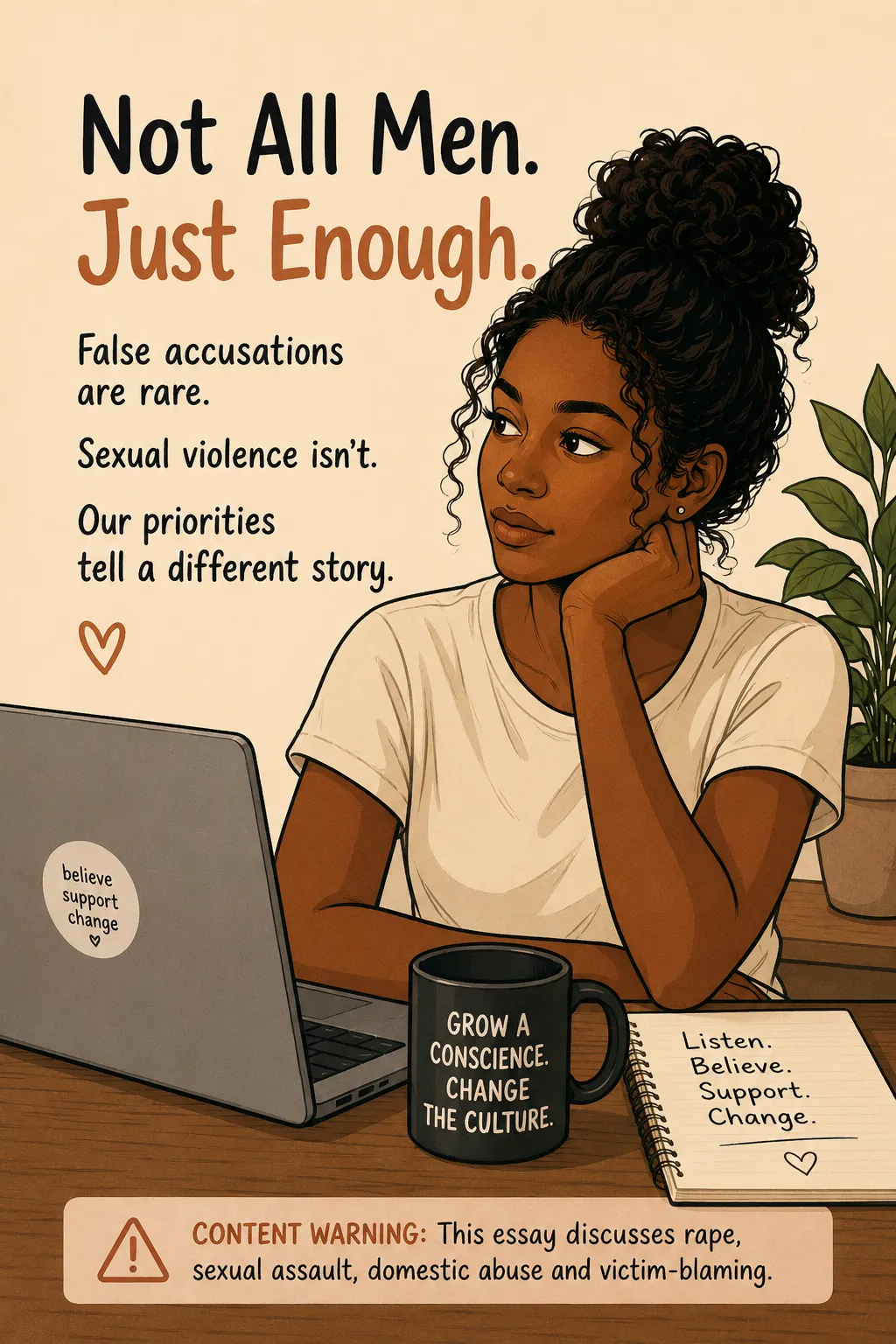
Every conversation about rape seems to end with someone worrying about men. I’m over it.
A heads up: This essay discusses rape, sexual assault and violence against women. Please take care while reading.
Every time I post about men who abuse women, without fail, someone slides into my DMs armed with a main course serving of misogyny disguised as nuance.
“This isn’t accurate.”
“What about false accusations?”
Or, inevitably:
“Not all men.”
Who said all men?
Not me.
I’m talking about men who abuse. The ones who know exactly where the line is and decide it doesn’t apply to them. The ones who convince themselves that persistence is romance, that coercion isn’t coercion, that being drunk somehow changes the meaning of consent.
If that isn’t you, why are you arguing with me instead of them?
Why does the conversation so often become about protecting men from scrutiny rather than protecting women from violence? Is preserving a man’s reputation more important than a woman’s safety? Because women live with the consequences of rape long after many men have rebuilt their reputations.
Do you think Conor McGregor cares that you defended him today? Do you think he knows you spent your afternoon arguing with strangers on his behalf?
Was that your contribution to ending violence against women?
Why are you more concerned with defending Conor McGregor than asking what it cost the woman who brought those allegations and pursued her case?
No matter how hard I try, I just can’t get my pretty little head around it.
Explain it to me again, sir.
Explain why protecting a powerful man’s reputation feels more urgent than asking what it cost a woman to come forward.
Then I have to hear about women lying…the false accusations.
Research consistently estimates that false reports of rape account for between 2% and 10% of reported cases, with many studies placing the figure closer to the lower end.
Yet this tiny minority dominates public debate.
Meanwhile, rape conviction rates remain notoriously low globally. Estimates suggest that fewer than 1–2% of rapes committed ultimately result in a conviction. It is also estimated that more than 60% to 90% of rapes go completely unreported to law enforcement.
Struggling with the maths? I got you bro.
If false reports represent a tiny proportion of reported cases, most rapes are never reported, and only a tiny fraction ever end in conviction, why have we organised an entire public conversation around protecting men from false allegations?
Around one in four victim-survivors report suicidal thoughts or behaviours after sexual violence. Many are several times more likely to attempt suicide than the general population.
Those are the lives I’m worried about.
The hypocrisy is hard to miss.
People are comfortable making sweeping statements about women.
Women are gold diggers.
Women are too emotional to lead.
A woman gets angry and someone asks whether she’s on her period.
People are comfortable reducing gay people, immigrants, Muslims, Black people, young people and entire generations to stereotypes.
We have built an entire culture on blanket statements.
The moment I point out that up to 98% of those prosecuted for sexual offences are male, or that victim-survivors report male perpetrators in the overwhelming majority of cases, suddenly everyone becomes deeply committed to nuance.
“Not all men.”
Of course not.
The irony is that many of the same people who reject any generalisation about men are perfectly happy to make them about everyone else.
Then there’s another argument I hear all the time.
“None of my friends would ever do that.”
Statistically, that is an extraordinary amount of confidence.
One of your friends has probably failed to recognise that ‘just the tip’ is simply coercion.
One of your friends didn’t wait to see if a woman was too drunk to have sex with her.
One of your friends has probably heard “no” often enough that it eventually became silence—and decided that was good enough.
Some men do not recognise what they have done as assault because we have normalised behaviour that erodes consent. Others know exactly what they have done.
I’ve looked men in the eye and told them I’ve seen their friend beat a woman.
They still went for drinks with him. They still called him a good guy. Nothing changed.
When women say men protect each other, this is what we mean.
This culture hurts men too.
Around 1.5 million men experience domestic abuse every year, and research suggests between 50% and 80% never report it or tell anyone.
The same culture that teaches men to defend other men at all costs also teaches male victims that speaking up makes them “weak”.
So no, I’m not interested in another debate about whether all men are violent.
I’m interested in the culture that teaches otherwise decent men to defend male reputations before asking what happened to the woman. The friends who stay silent. The colleagues who look away. The institutions that protect themselves. The strangers who spend more energy worrying about hypothetical false allegations than the millions of women living with the consequences of very real violence.
Grow a freakin’ conscience, bro.
Although after years of having this conversation, I’ve learned not to expect one.
Because every opportunity to villainise a woman and protect your bro seems easier than facing the possibility that the man you’re defending is exactly who she says he is.