On audacity, restraint, and the women living underneath our professional selves
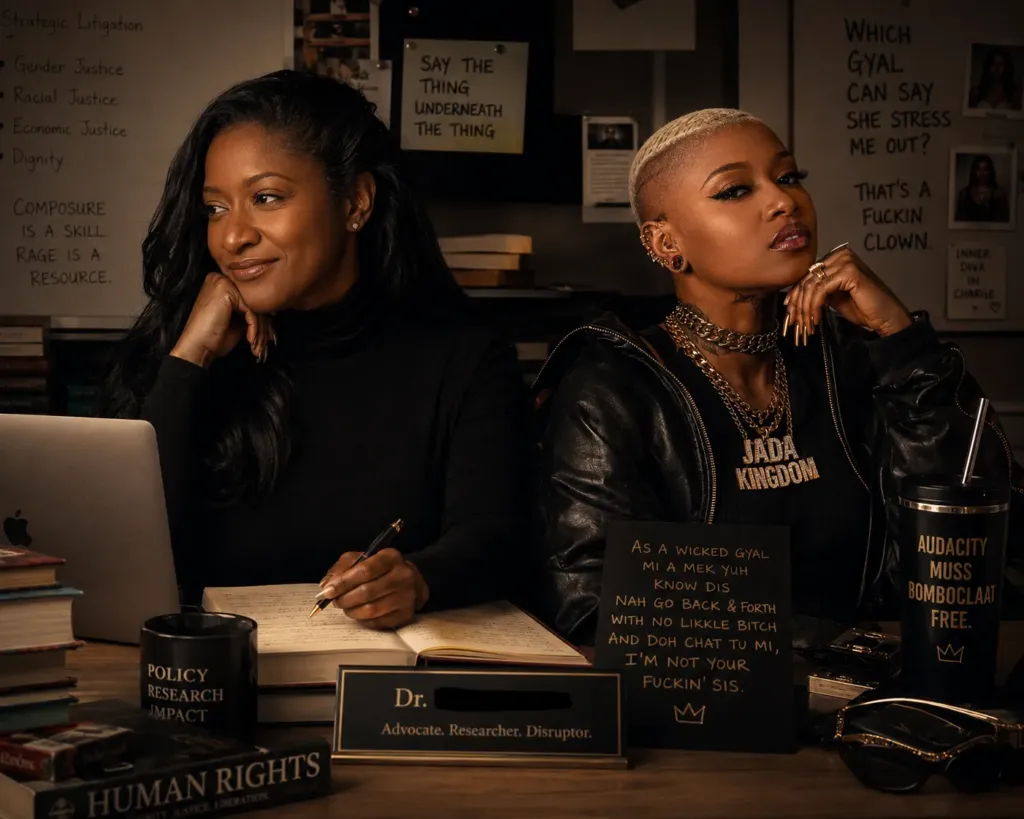
There are women we admire because they reflect us back to ourselves.
And then there are women who feel like release valves. Women who carry the parts of ourselves we were taught to restrain.
For me, that woman is Jada Kingdom.
Which, to anyone who knows me personally, sounds slightly absurd.
I am measured to a fault. Most of my life exists inside frameworks that require composure. Academia. Advocacy. Policy. Human rights work. Rooms where language has to arrive washed, pressed, and defensible. I know how to soften the edges of what I feel before offering it up for public consumption. I spend an unusual amount of time translating rage into something institutionally digestible.
Even my anger arrives with citations.
Fury often travels further when it sounds polished. So I learned how to make myself legible inside rooms that reward restraint.
As liberal as I am politically, I still operate with fairly conservative emotional instincts. I am shy. Fairly quiet unless somebody says something that exposes the limits of their politics.
I mean the gap between what people claim to believe and what they can actually tolerate. The point where equality becomes inconvenient. The moment progressive values collide with power, money, race, gender, or self-interest.
Only then do I transform into a tired lecturer who has spent too much time watching people weaponise the language of liberation without understanding the labour beneath it.
And yet my spirit animal is Jada Kingdom.
I even named my car after her.
Twinkle.
In a Jamaican context, this is perhaps the clearest indication that the attachment runs deeper than casual fandom.
What fascinates me about Jada is not simply her confidence. It is her precision.
People often reduce dancehall women to spectacle because they mistake vulgarity for a lack of intelligence. Jada’s writing exposes that mistake.
In “You Alone,” desire becomes almost tangible. She writes in a way that appeals to every sense at once. Sound. Texture. Movement. She creates a space where you feel close enough to inhabit it.
Then there is the other side of her catalogue.
The side that gave us “London Bed” and “Accept Dat.”
Those songs confirmed for me that she is one of the sharpest lyricists in dancehall.
A good diss track is not really about insults. It is about observation. Seeing people clearly enough to understand exactly where their vulnerabilities sit and then building a story around them.
Jada excels at that.
Her lyrics feel specific rather than manufactured. The irritation feels earned. The details linger.
And beneath much of her work sits the same recurring theme:
Refusal.
Refusal to surrender authority over your own story.
Refusal to accept somebody else’s version of who you are.
One of my favourite Jada observations is:
“Audacity muss bomboclaat free.”
A line that somehow manages to explain an astonishing amount about how power operates.
Because the audacity is absolutely free.
Free in boardrooms.
Free in relationships.
Free inside the men who quietly pay for abortions while insisting publicly they do not believe women should have the right to one.
Free inside feminist spaces where white women quote Audre Lorde at conferences but still clutch their handbags tighter when Black women walk past them at night.
Free inside the man who interrupts you only to repeat the very thing you just finished saying.
Jada is ostensibly talking about the audacity of other people: the people who overstep casually, disrespect her, and then act shocked when she responds.
But the line works in both directions.
It is a criticism of unearned confidence and a declaration of her own refusal to shrink.
A complaint and a manifesto in seven words.
And perhaps that is why it resonates so deeply.
Black women are often permitted one kind of audacity at a time.
Intellectual audacity.
Political audacity.
Professional ambition.
But women who are sexually expressive, emotionally loud, visibly self-assured, and intellectually sharp all at once still make people uncomfortable.
Jada refuses those boundaries entirely.
What I hear in that line is freedom.
Freedom from constant translation.
Freedom from turning every sharp edge into something more acceptable for other people.
There is something deeply satisfying about women who refuse compulsory softness. Women who do not immediately convert every feeling into something educational, nurturing, or emotionally accommodating for everyone around them.
Women who allow themselves displeasure without wrapping it in apology.
That is why I hear Jada most clearly in the space between what I think and what I say.
She says the thing diplomacy keeps trapped in your throat.
I think all women have an alter ego. A shadow self.
A woman who appears privately before you send the measured email.
Before you choose professionalism again.
Before you swallow the response sitting at the back of your mouth.
Mine has tattoos and a voice softer than her opinions.
Speaks patois.
Believes audacity is, in fact, free.
And answers to Twinkle.