Your life does not require anyone else’s permission
I think most of us want to be validated.
We want somebody to think we are beautiful, clever, funny, talented, necessary. Even the people who insist they have transcended the need for approval have usually found more sophisticated ways of collecting it. The footballer who pretends not to notice when somebody gawks at what he can do with a ball. The musician who blushes when you tell her you listened to her song on repeat. The person who says they do not care what anybody thinks, then tells you, in considerable detail, about all the things they have accomplished without anybody’s help.
We all have our thing.
Mine has always been usefulness.
I am not one of those people who arrived on earth with some obvious, spectacular talent. I cannot sing. I cannot draw. My dancing is enthusiastic rather than technically impressive. I am reasonably intelligent and I have worked very hard, but there has always been somebody smarter, faster, more naturally gifted.
So somewhere along the way I learned to ask a different question.
How can I help?
How can I make this easier?
How can I be useful to you?
It is a dangerous thing to build your sense of worth around a question that can always be answered with more.
There is always another person who needs something. Another email you can answer. Another friend you can help. Another problem you can solve. Another request you can accommodate if you move a few things around, sleep a little less, cancel something you wanted to do and convince yourself it really isn’t that deep.
For much of my life, I thought being needed was evidence that I mattered.
I grew up in a family where achievement carried enormous weight. My parents loved us fiercely, but their love existed alongside expectation, sacrifice and a profound fear of disappointment. Excellence was the floor. Respectability mattered. Their lives had been shaped by migration, race, class and the determination to build something better, and we understood that what had been built for us came with responsibility.
By adulthood, usefulness felt almost instinctive. Helping had become part of my identity and, if I am being less generous with myself, part of the evidence I collected to prove that I deserved love.
Then my parents died.
Afterwards, my therapist and I spent an almost embarrassing number of sessions talking about decisions.
Everyday, ordinary decisions.
“What do you want?”
How many of us really know the answer to that?
For most of my life, decisions had travelled through an elaborate internal committee before reaching me. Who will this disappoint? Who needs me? What is expected? What is responsible? What creates the least inconvenience for everybody involved?
My own desire occasionally made the agenda somewhere near Any Other Business.
Their deaths left an enormous absence. Inside that void was a freedom I did not know what to do with. I had spent so much of my life orienting myself around the needs, expectations and survival of other people that choosing my own life felt almost irresponsible.
I am still learning that caring for yourself is not self-indulgence.
I remain somebody who says yes far more easily than I say no. My no usually arrives dragging an entire entourage behind it: I’m so sorry. I would absolutely love to. It’s just that this week is a little difficult because…
Paragraphs of supporting evidence and, where necessary, character witnesses.
A small PowerPoint presentation explaining why I cannot accommodate a request that occasionally should have received nothing more than, “Sorry, no can do.”
Meanwhile, I have always possessed extraordinary boundaries on behalf of everybody I love.
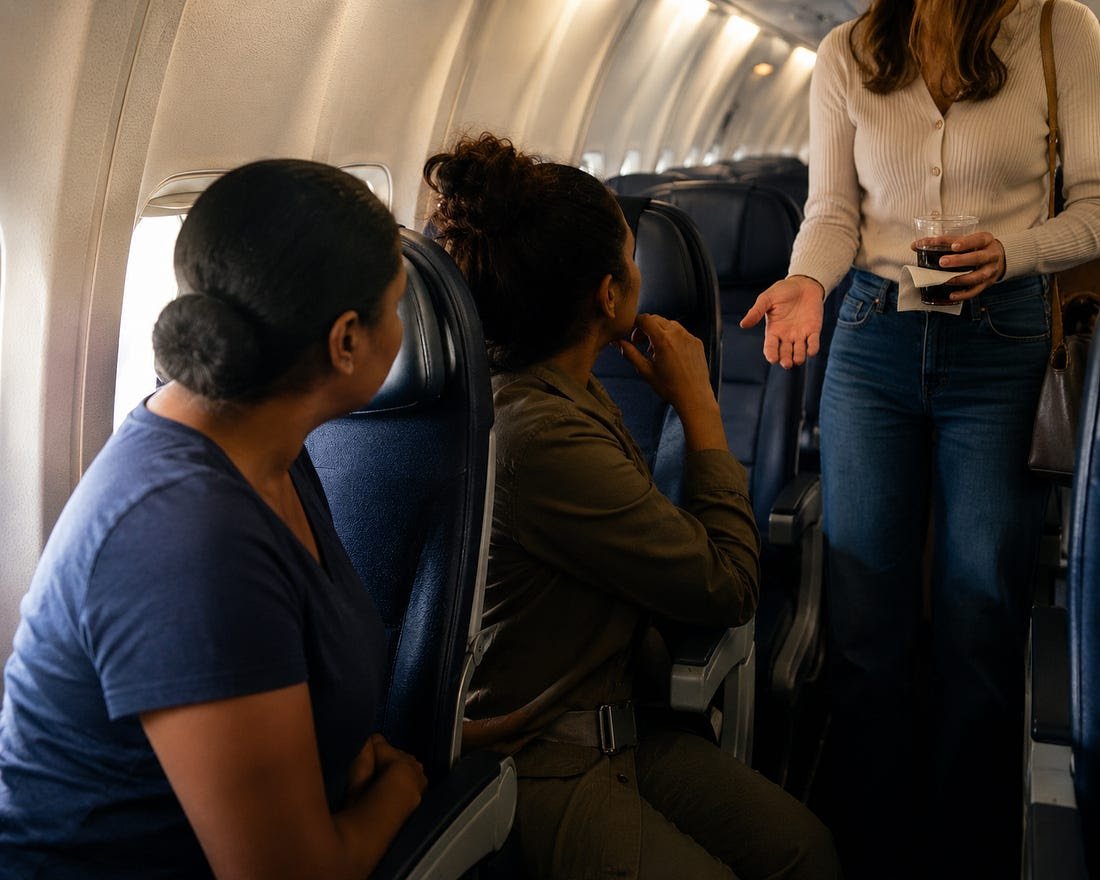
My sister Dhara and I are catching a flight to Florida. We are already seated when the woman assigned to the middle seat eventually appears, taking her good sweet time getting herself organised in the aisle.
She looks at my sister and says, “Can you hold my drink for me?”
There is absolutely nothing wrong with this request.
My sister, being one of the sweetest human beings alive, takes the drink without a second thought. I would probably do exactly the same thing if somebody asked me.
But she has asked Dhara.
And suddenly I am internally preparing for war.
I watch this woman as though she has committed an offence against the Crown. In my head I call her several things her mother certainly did not name her. I develop arguments, rebuttals and closing submissions. I am prepared to defend my sister’s constitutional right not to hold this stranger’s beverage.
Of course I say none of it.
That would not be useful to anyone.
So I sit there quietly, furious on behalf of a woman who is completely unbothered, and somewhere between Jamaica and Florida I am confronted with something ridiculous about myself.
I know how to defend people.
I have built much of my life doing it. I know how to enter rooms where somebody’s experience is being dismissed and insist that it matters. I know how to advocate professionally and personally, how to make an argument difficult to ignore, how to stand beside somebody whose voice is being diminished and create enough room for them to be heard.
I have a voice. I use it well.
So why have I so often behaved as though I am the only person who does not deserve its protection?
Part of the answer is that having boundaries requires more responsibility than people pleasing allows us to admit.
We people pleasers love to tell you how exhausted we are. We are drained, overwhelmed, pulled in ten directions. Everyone wants something from us. Nobody understands how much we are carrying.
Sometimes all of that is true.
It is also occasionally incomplete.
Not everybody asking something of you is trying to exploit you. Sometimes they simply cannot see the person flailing on the other side of the request. And that is on us.
They cannot see that you answered their email while eating dinner, agreed to the meeting while already over capacity, said you would come to the birthday when what you really wanted was twelve hours without another human speaking to you.
Why would they?
You smiled, said yes with great enthusiasm and offered to bring cookies.
Then you quietly resented them for believing you.
That has been one of the harder things for me to admit. People are not responsible for discovering boundaries I have refused to communicate. They are not required to study my tone for signs of exhaustion or recognise that the cheerful yes I gave them actually meant, I am barely holding myself together but I am terrified you will think less of me if I say no.
Sometimes the person asking is inconsiderate. Sometimes the request is unreasonable. Sometimes people absolutely will take everything you offer and return with an empty plate asking what else is available.
And sometimes they simply asked.
I volunteered the rest.
Being overwhelmed when you are a people pleaser is easier because exhaustion gives you an innocence boundaries do not. If I am exhausted because everybody needs me, then I am indispensable. If I am exhausted because I keep saying yes, then eventually I have to confront the possibility that I have choices.
Being drained can be easier than having boundaries.
A boundary risks disappointing someone. It may change the way somebody sees you. It means saying, “I can’t do that,” while knowing perfectly well that technically you could. You could cancel something. You could work late. You could rearrange your day. You could sacrifice the quiet evening you needed.
The truth might simply be that you don’t want to.
For somebody accustomed to usefulness, I don’t want to is profanity.
I am trying to become less frightened of it.
Im slowly turning my apartment has increasingly become a people-free sanctuary. I need quiet days where nobody requires anything from me. I need music, food, books, television I barely watch and the ability to let several hours pass without answering a question.
I am recognising that these things are more than rewards I earn after everybody else has been satisfied. They are a huge part of how I remain myself.
That also means speaking before I have spread myself so thin that I begin blaming other people for the holes. It means accepting that I can change my mind, that my capacity can change after I have agreed to something, and that I do not need to manufacture an emergency dramatic enough to justify prioritising myself.
I also do not need to remain anywhere my value depends upon my ability to prove it.
One evening, I walk into a bar and see someone I love, but I feel their anger without words being exchanged. The sharpening of their eyes when they land on me. The tightening of their face. The disdain travelling across the room with enough force to feel kinetic.
I know this face. I know those eyes when they soften. I know what it is to have them meet mine with warmth. Perhaps that is why their hardness feels so physical.
Every instinct I have tells me to go over.
Make them understand that I am still the person he knew. Tell them that whatever I got wrong does not erase everything I got right. Defend my intentions. Find the precise arrangement of words that might make their face soften again.
I know how to do this. I have spent much of my life finding the words that make people listen.
So I move to the other side of the bar.
A few feet of floor. A decision that takes seconds.
They are entitled to their anger. I am accountable for the hurt I have caused, for the things I would undo or do differently if life offered such convenient revisions. Their body is also telling me that my presence is unwelcome.
So I leave them alone.
For perhaps the first time, I also leave myself alone.
I don’t spend the evening monitoring their face for an opening. I don’t prepare the defence in my head or wait for the precise moment when I might make my case. I don’t ask them to reassure me that beneath the anger they remember who I am.
I stay on my side of the bar.
I understand that neither love nor remorse obligates me to keep auditioning for tenderness.
The same applies to arguments where the only available outcome is further disrespect. I have spent enough of my life finding the right words. I am becoming more discerning about where I place them.
I suspect some part of me will always be a people pleaser. I like helping people. I like being dependable. I like being the person you can call when everything has gone to shit and you need somebody who will answer the phone, find the document, make the plan, bring food, ask the right question or sit beside you without requiring you to make your pain presentable.
I have no interest in becoming less generous.
I want the generosity to be more intentional.
A yes freely given has a different weight from one extracted by my own fear of disappointing someone. Service feels different when it is chosen rather than used as the admission price for belonging. And exhaustion looks different when I am willing to admit the role I played in creating it.
Maybe that is what boundaries have come to mean for me.
Ownership.
People can ask. They can need. They can be disappointed by my answer. They can misunderstand me, dislike my decision, even decide that the version of me with boundaries is less useful to them than the one without them.
My life still belongs to me.
After years of asking How can I help? How can I make this easier? How can I be useful to you? I am trying to give another question equal weight.
What do I want?
No supporting evidence required.