I came to Assata late in life. A friend and colleague pressed her autobiography into my hands, and I devoured it. It didn’t sit on me the way other political texts had. It shifted something deep inside me. Reading her was not an intellectual exercise—it was a bodily one. Her words made my chest heavy and my spine straighten, as if she were reminding me that struggle is not an abstract ideal, but something we inherit, carry, and live.
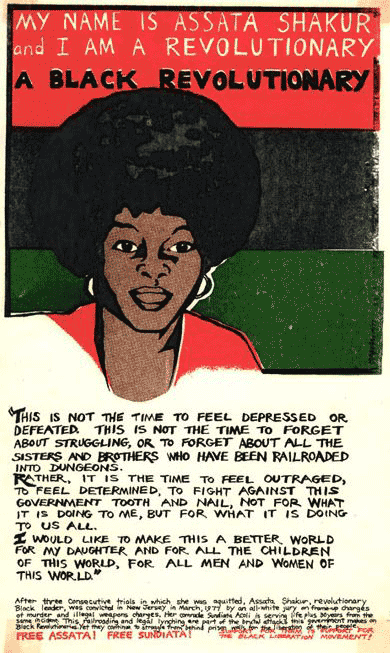
Assata Shakur was only a year older than my mother. By the time my mother brought me into this world, Assata had already faced death, fascism, racism, and the full weight of a state determined to erase her. She had already been shot, imprisoned, tortured, and driven into exile in Cuba. She had already chosen her name—Assata Olugbala Shakur—“She who struggles, love for the people, the thankful.” She was living proof of how Black women re-name and re-make themselves in the face of unimaginable violence.
And still, her centre was always her people. Especially Black women. She wrote of the women who raised her, women who could wring a chicken’s neck, deliver babies, boil clothes white, and hum lullabies while stirring soup for the sick. Women who walked with majesty, who carried responsibility not just for their own children but for the entire community. It is from them, she insisted, that she learned her struggle. It is from them that she drew her audacity.
The state called her a fugitive. The people knew her as a freedom fighter. While evidence corroborated her innocence, she was sentenced to life plus thirty-three years in prison—a punishment meant to destroy not only her body, but the possibility of Black liberation itself. And still, even handcuffed to a hospital bed, mocked by police and doctors as she bled, Assata refused to surrender her humanity.
I never met her, but I feel her in my marrow. Not as nostalgia, not as myth, but as living instruction. She showed us that joy is not frivolous, freedom is not theoretical, and both demand sacrifice. I don’t think she would want us to mourn her. She knew her struggle was never just her own—it was for us. To teach us that freedom is possible. To insist that joy is worth fighting for.
I carry gratitude for her life. And I hope to fight in a way she would recognise. In a way she would be proud of.